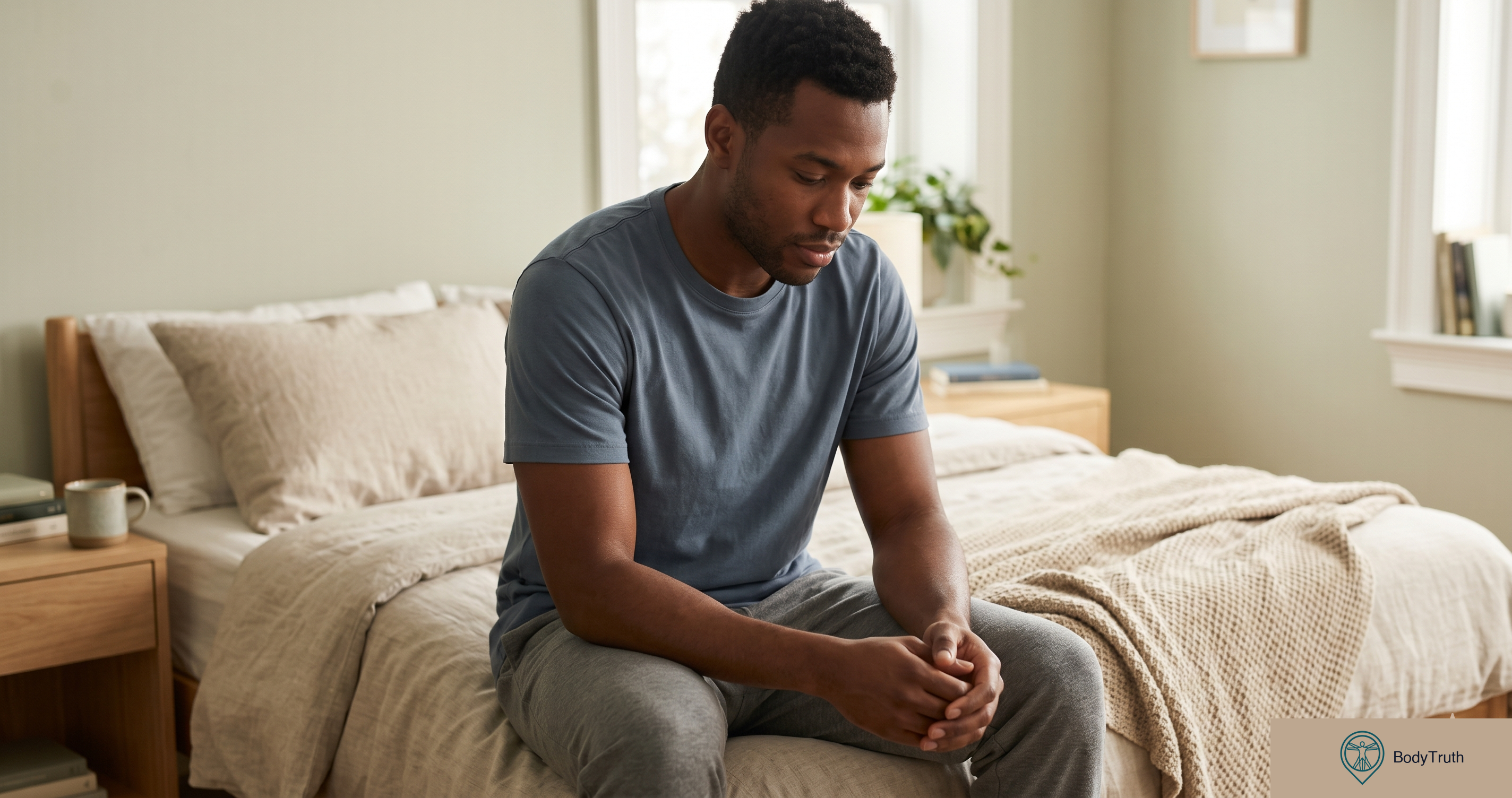
You’re in your twenties or early thirties. You’re healthy. You work out, you eat reasonably well, nothing’s physically wrong with you. And yet — when it matters, when you’re actually with someone — it doesn’t work. Or it half works. Or it works alone but not with a partner.
And you can’t talk about it. Because men your age aren’t supposed to have this problem. So you carry it silently, it makes you anxious, the anxiety makes it worse, and the cycle tightens.
Let’s break this open. Because what’s happening to you is increasingly common, well-understood, and almost always fixable — once you understand the actual cause.
It’s Not Rare Anymore
Here’s something that might help immediately: you’re not alone, and this isn’t unusual.
A 2013 study in The Journal of Sexual Medicine found that ED affects approximately 26% of men under 40. A quarter. That study wasn’t an outlier — multiple subsequent reviews confirmed similar numbers.
This represents a significant increase compared to older data. Something has changed in the last 15–20 years. We’ll get to what.
The Two Categories
ED in young men almost always falls into one of two buckets:
1. Psychological / Behavioral (the vast majority — 80%+)
- Performance anxiety
- Porn-related arousal conditioning
- Stress, sleep deprivation, depression
- Relationship issues
2. Physical (less common in young men, but real)
- Hormonal issues (low testosterone)
- Cardiovascular problems
- Medication side effects (SSRIs, finasteride, blood pressure meds)
- Pelvic floor dysfunction
Here’s how to tell which one you’re dealing with: Do you get erections when alone — morning erections, erections to porn, erections during sleep? If yes, the hardware works. The issue is psychological or situational. If you genuinely never get erections in any context, that’s worth a blood panel and a doctor visit.
For most young men reading this, it’s category one. Let’s go deep on each cause.
Performance Anxiety (The Most Common Cause)
This is the silent epidemic. And it works like this:
- Something goes wrong once — you’re nervous, you drank too much, you’re with a new partner, whatever
- You notice it didn’t work
- Next time, you’re thinking about whether it’ll work instead of being present in the moment
- The worry itself prevents arousal (your nervous system switches from “rest and arouse” to “fight or flight”)
- It doesn’t work again
- Now you’re convinced something is wrong with you
- The cycle repeats and intensifies
This is not a physical problem. It’s an anxiety loop. Your body works fine — your brain is getting in the way. Erection requires parasympathetic nervous system activation (calm, relaxed state). Anxiety triggers sympathetic activation (stress state). They’re physiologically incompatible.
How to know it’s this: You get hard fine when alone, watching porn, or in low-pressure situations. It fails specifically with a partner, or specifically when penetration is expected.
What helps:
- Understanding the mechanism (you’re reading this now — that’s step one)
- Taking penetration off the table temporarily — removing the “pass/fail” pressure
- Mindfulness during sex — focusing on sensation, not performance
- Open communication with your partner (more on this below)
- Cognitive behavioral therapy with a sex therapist (highly effective for this)
Porn-Induced Erectile Dysfunction (PIED)
This is the one nobody talked about ten years ago, and now research is catching up.
The pattern: A man who started watching high-speed internet porn in his early teens finds that, by his twenties, he can get hard to porn but not with a real partner. Or he needs increasingly extreme/specific material to get aroused. Or he can only maintain an erection by mentally replaying porn during real sex.
What’s happening neurologically: The brain’s arousal pathway has been conditioned through thousands of repetitions to respond to screen stimuli — specific visuals, novelty, escalation. A real partner — slower, less visually extreme, requiring emotional presence — doesn’t trigger the same response. It’s not that the real partner isn’t attractive. It’s that the brain’s reward circuitry has been recalibrated.
A 2016 review in Behavioral Sciences documented this phenomenon and proposed that high-speed internet pornography creates dopamine-related changes similar to other behavioral conditioned responses.
How to know it’s this:
- You need porn to get hard or to finish
- You’ve escalated to more extreme material over time
- Real-life partners feel “less stimulating” than screen content
- You started heavy porn use in adolescence
What helps:
- Reducing or eliminating porn consumption (most men report improvement within 30–90 days)
- Reconnecting arousal response to physical sensation rather than visual stimulation
- Patience — neural pathways take time to recalibrate
- Some men benefit from a structured “reboot” period with professional guidance
Stress, Sleep, and Depression
Less dramatic but extremely common: your lifestyle is killing your erections.
Chronic stress keeps cortisol elevated, which directly suppresses testosterone and interferes with arousal signaling. If you’re working 60-hour weeks, barely sleeping, and constantly in fight-or-flight mode — your body is prioritizing survival, not reproduction.
Sleep deprivation (under 6 hours consistently) reduces testosterone by up to 15% within one week. That’s a direct hit to your libido and erectile function.
Depression — both the condition itself and SSRIs used to treat it — are strongly associated with ED. If you started antidepressants and your erections changed, that’s likely the medication. Talk to your doctor about alternatives (bupropion has lower sexual side effects).
What helps: Honestly? The boring stuff. Sleep 7–8 hours. Manage stress. Exercise (proven to improve erectile function — 40 minutes of moderate aerobic exercise 4x/week showed significant improvement in multiple studies). Address depression with professional help.
The Relationship Factor
Sometimes the cause isn’t internal — it’s relational.
- Unresolved conflict with your partner
- Loss of attraction (can happen and doesn’t make you a bad person)
- Feeling pressured or criticized about sexual performance
- Emotional disconnection during sex
- Partner’s reaction to previous ED episodes creating more pressure
This is harder to address alone. Couples therapy or sex therapy with both partners present is often the most effective approach here.
When to See a Doctor
See a doctor if:
- You never get erections in any context (including morning erections)
- You have other symptoms: fatigue, weight gain, loss of body hair, depression
- You’re on medications that may cause ED
- You’re over 35 and this is new — cardiovascular screening is worth doing
- You’ve tried addressing psychological factors for 2–3 months with no improvement
What they’ll check: testosterone levels, thyroid function, cardiovascular health, medication review. If everything comes back normal — the cause is almost certainly psychological.
What About Viagra/Cialis?
They work. They’re safe for most young men. And they can be useful as a temporary bridge to break the anxiety cycle — not as a permanent solution.
Here’s how to use them intelligently: take one a few times to prove to yourself that your body CAN work. Once the anxiety cycle breaks and your confidence returns, most young men find they don’t need it anymore. The drug didn’t fix the problem — it broke the fear loop long enough for your brain to remember that things work.
Do NOT rely on them long-term without addressing the underlying cause. They mask symptoms. If the cause is anxiety, porn conditioning, or lifestyle — those still need to be addressed.
What to Tell Your Partner
This is the part most men skip. But communication with your partner is often the single most effective intervention.
What to say: “This isn’t about you. I’m dealing with some performance anxiety. The more pressure I feel, the worse it gets. What would really help me is if we could take penetration off the table for a while and just focus on enjoying each other without a goal.”
Why it works: It removes the pass/fail dynamic. It reframes sex as exploration rather than performance. It brings your partner onto your team instead of making them feel rejected (which is what they’re often feeling and not saying).
Most partners respond with relief and support. They thought it was about them. Knowing it isn’t changes everything for both of you.
Key Takeaways
- ED affects ~26% of men under 40. You’re not broken. You’re not unusual.
- If you get hard alone but not with a partner — the cause is psychological, not physical.
- Performance anxiety is the #1 cause in young men. It’s a self-reinforcing loop that can be broken.
- Porn-induced ED is increasingly common. Reducing porn use typically resolves it within 1–3 months.
- Sleep, stress, and exercise have direct, measurable effects on erectile function.
- Communication with your partner is often the most effective single intervention.
- Viagra/Cialis can break the anxiety cycle but shouldn’t replace addressing root causes.
- See a doctor if you never get erections in any context or have other hormonal symptoms.
Sources
- Capogrosso P, et al. “One patient out of four with newly diagnosed erectile dysfunction is a young man.” The Journal of Sexual Medicine, 2013.
- Park BY, et al. “Is Internet Pornography Causing Sexual Dysfunctions?” Behavioral Sciences, 2016.
- Silva AB, et al. “Physical activity and exercise for erectile dysfunction.” British Journal of Sports Medicine, 2017.
- Levin RJ. “The mechanisms of human erection.” Sexual and Relationship Therapy, 2017.
- Montorsi F, et al. “Summary of the recommendations on sexual dysfunctions in men.” The Journal of Sexual Medicine, 2010.
This article is for educational purposes only and does not constitute medical advice. If you have concerns about your health, please consult a qualified medical professional.
Don't leave it to the algorithm.
One article, straight to your inbox, whenever we publish. Written for humans, backed by research, free of clickbait.
Zero spam. One click to leave. Your inbox, your rules.